
Many people label ChatGPT as ‘artificial intelligence,’ ‘chatbot,’ ‘large language model,’ ‘virtual assistant,’ or ‘generative AI.’
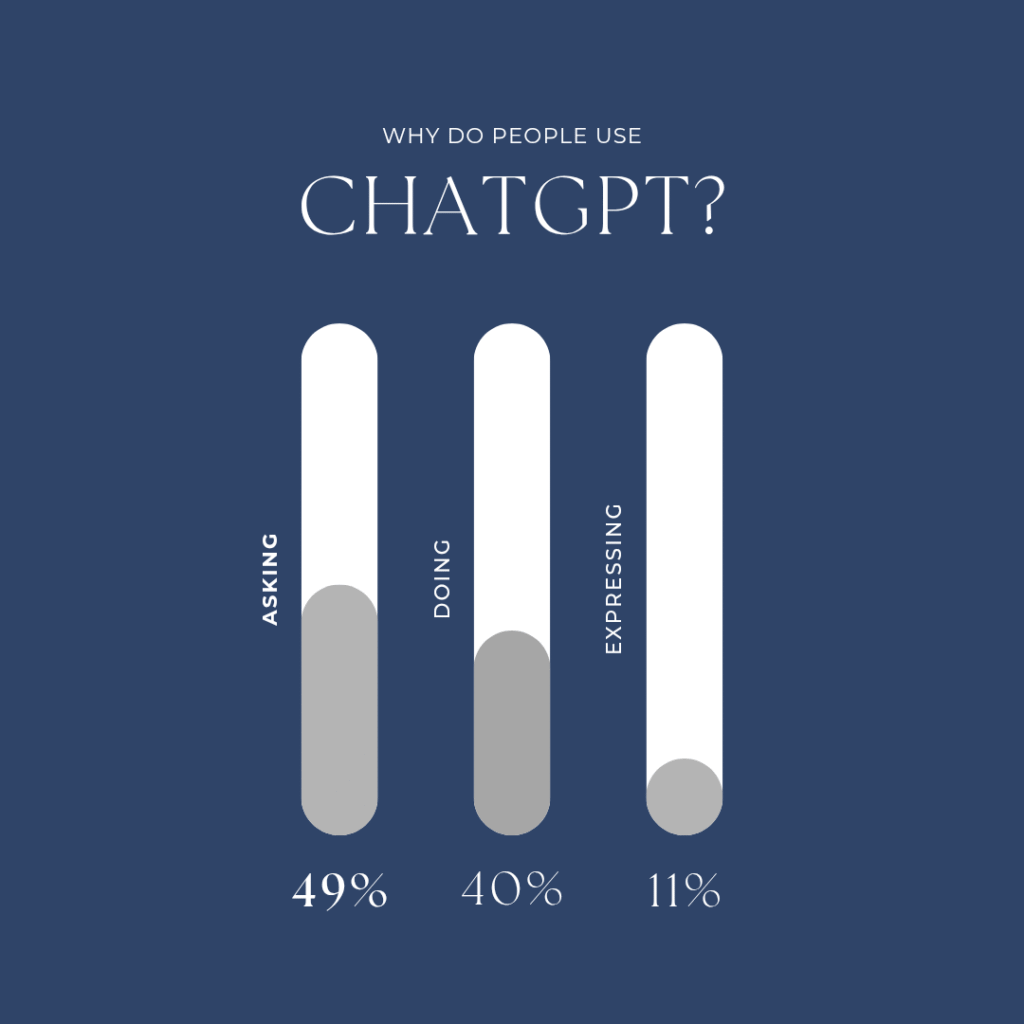
But according to the most comprehensive study ever conducted on its consumer usage, the most accurate label is ‘answer engine.’ The data shows that nearly half (49%) of all user messages to ChatGPT contain a question—proving that users primarily expect answers.
Key Takeaways:
- 49% of user messages contain questions: ChatGPT’s strongest identity is as an answer engine.
- 70% of usage is everyday-life related, only 30% is work-related: Large-scale opportunities in B2C, high-value opportunities in B2B.
- Educated and high-income users ask more work-related questions: Tailored AEO strategies are needed for the premium segment.
- The growing quality and volume of everyday questions show ChatGPT is evolving into a life coach.
- Website visits are disappearing from the decision-making chain. Answer engines directly influence decisions.
- This shift requires developing new AEO metrics and measurement models.
We’re Turning to ChatGPT for Everyday Questions
The study categorizes consumer usage patterns into three types: asking, doing, and expressing.
Nearly half of all messages fall into the asking category. This shows that more and more people are turning to ChatGPT as a life coach to find answers to their questions.
With around 30% of consumer usage being work-related and 70% non-work-related, ChatGPT is perceived more as a life coach than a professional business consultant.
The fact that highly educated and well-paid professionals are more likely to use ChatGPT for work-related purposes opens a unique gateway to reach high-value customer segments.
The research also highlights that non-work-related queries are growing faster than work-related ones. Furthermore, ‘asking queries’ are generally of higher quality than ‘doing queries’. This may indicate that people use ChatGPT more carefully to support their decision-making processes.
User Behaviors Are Shaping the Direction of AEO Strategies
The 30% work-related vs. 70% everyday-use balance tells companies and content creators:
- B2C opportunity: Everyday questions (health, food, shopping, personal development, travel) offer massive volume for AEO.
- B2B value: Work-related questions from educated, high-income users are lower in volume but higher in commercial value.
This shows that AEO strategies need to evolve in two directions:
- Inclusive (mass) content for everyday questions.
- Focused (premium) content for professional audiences.
The Future of AEO: Unmeasurable Values, New Opportunities
According to the study, ChatGPT creates a great value by supporting consumer decision-making. This created value is not captured by traditional measurement tools such as GDP. The inability of traditional tools to capture this value is, in fact, the most striking finding about the future of AEO.
ChatGPT influences users’ decision-making processes (what product to buy, what method to choose, how to act), but it does so by transforming the classic funnel logic. Users now make decisions directly, without necessarily visiting a website.
This transformation expands the scope of AEO beyond the search box, shaping decision-making frameworks across all areas of life. As a plugin for answer engine industry, AEO is therefore generating a new kind of value—one that cannot be easily captured by traditional metrics but must nevertheless be measured. This makes it essential to develop new metrics, different analytical approaches, and user-centered measurement models in AEO.


